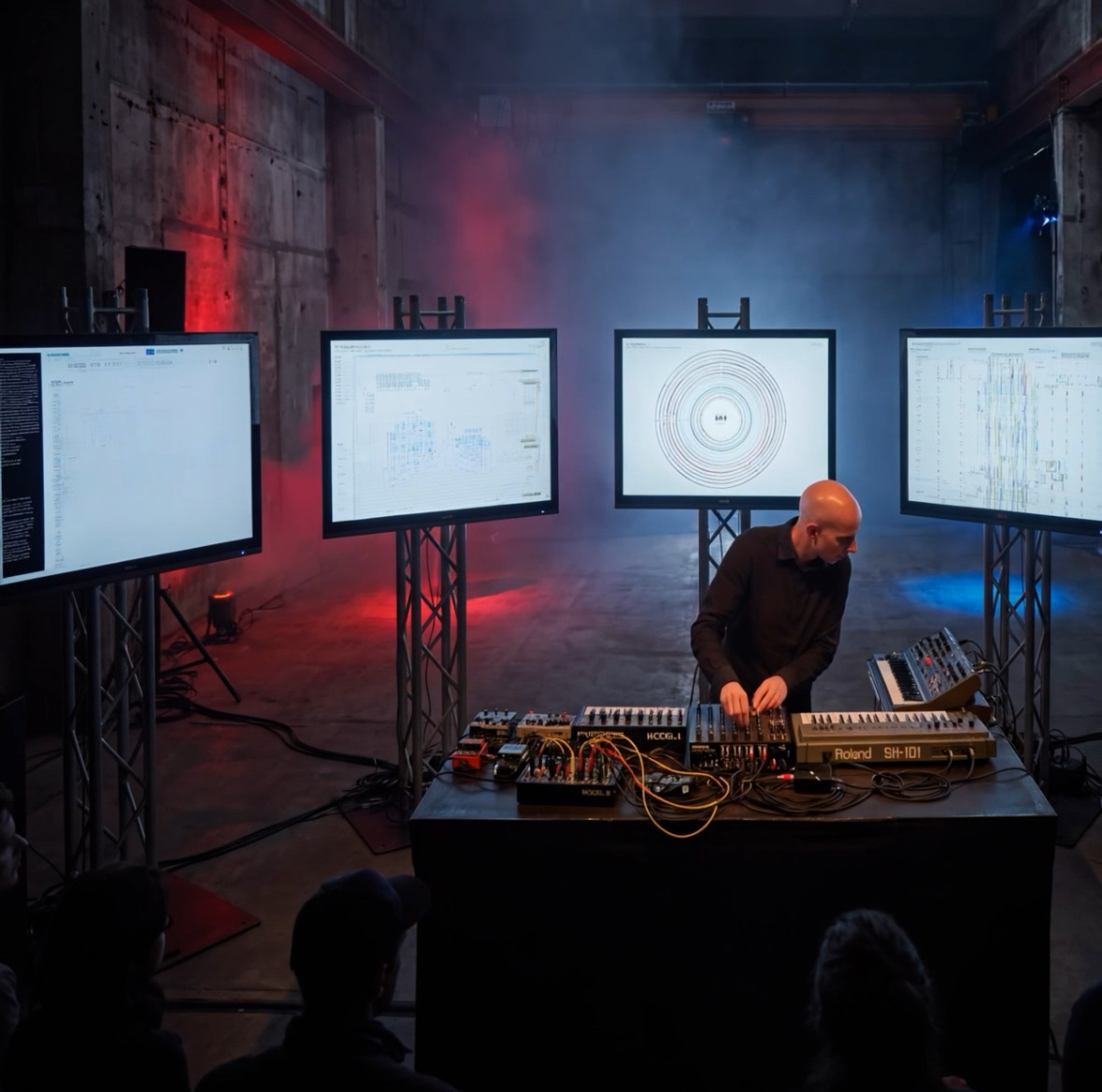
Mockup for an audiovisual set built on Rhythm Logic, a system in development
About
Lucas Kuzma is a Berlin-based artist, musician, and research engineer. He builds generative systems, in image and in sound, that have tendencies of their own, and works with them as an interlocutor rather than an operator. The same expertise runs through his career in applied machine learning, from diffusion models to computer vision to real-time systems, and the two sides of the practice continually feed each other: the engineering gives the art its technical depth, and the art leads him to build systems no product roadmap would ask for.
The question running through all of it is what emerges when human intention, rule-based procedure, and learned models are made to negotiate. He calls the approach xenotranslation: treating machine intelligence not as a tool to be controlled but as a genuinely alien logic, with its own training, its own biases, its own aesthetic habits. Following Byung-Chul Han, he looks for beauty that wounds rather than pleases. Most AI-generated work samples from the familiar; his systems are built so that neither the procedure nor the model can fall back on its defaults, and what survives the collision is genuinely strange.
In the image work, procedural geometry is forced through diffusion models fine-tuned on deliberately constrained visual vocabularies. The resulting Xenobotanical Experiments are specimens from parallel evolutionary pathways, botanical forms alien to both human design and machine training. He presents them as taxonomic documentation, using the image model as an imaging instrument rather than a generator, so that each picture is both experimental result and archival record. The series grew out of his earlier research into render-guided machine learning lifeforms, and is collected as the first issue of Terminal Archive.
In sound, the same idea takes the form of instruments that push back. Lucas has performed and released electronic music as Claus Muzak since the 1990s, much of it on his own Philtre Com label, and builds some of the instruments he plays. In 2004, for his MFA thesis at UCLA, he made a network of 3D-printed and cast ceramic audio devices running neuron simulations: autonomous sounding objects that listened and responded to each other and to their environment. At the Music Technology Group of Universitat Pompeu Fabra he designed interfaces for a real-time concatenative synthesis system. And through The Strange Agency he built a family of touch-based granular synthesizers for iOS, beginning with Curtis in 2010 and continuing with MegaCurtis, Soup, and Open Granular, that treated recorded sound as a physical material to be scratched, stirred, and poured. The apps reached over a million downloads and were presented at Stanford’s Center for Computer Research in Music and Acoustics and, in the talk Seeing Sound, at the University of Illinois at Chicago Innovation Center.
Two decades after the ceramic network, the artificial nervous systems are back at the center of the work. Small Network evolved a small spiking neural network into a compositional engine working across three Japanese pentatonic scales; its raw scores, interpreted by hand in Ableton Live, were released as Sonic Mandala by The Psychic Geometries Trio, “an ensemble whose three members happen to share a single nervous system.” Folded Bodies inverts the relationship between instrument and performer: the network lives on a three-dimensional body that the performer folds live across mirror planes, so reshaping the visible geometry rewires the network and recomposes the music. The performer chooses the body; the body chooses the music. He now also performs it as a quartet with Sébastien Roger, two humans and two networked artificial nervous systems, each machine becoming the other’s environment. Along the way he created the music and visuals for the Christine Bonansea Company’s dance works GAMER and Artificial Archeology, staged at DOCK 11 Berlin and Teatros del Canal Madrid. Artificial Archeology began with LiDAR scans of Paris from his time at Fantasmo, excavated with generative models into speculative pasts and futures.
The range has an unusual foundation: a BA in Philosophy and a BS in Computer Science with a minor in Artificial Intelligence from Case Western Reserve University, an MFA in Design | Media Art from UCLA, and an MS in Information, Communication and Audiovisual Media Technologies from Universitat Pompeu Fabra. In industry, he most recently led applied ML research and engineering at Graswald, spending a year on neural radiance field and 3D Gaussian splatting reconstruction before pivoting to diffusion models, where he directed experimentation across LoRA fine-tuning and conditioning strategies for generative imaging. Before that, at Fantasmo, he bridged computer vision research and production engineering for a camera-based localization system that recovered a device’s full six-degree-of-freedom position from a single image, matched against digital twins of the city. After Fantasmo was acquired by TIER Mobility, he served there as Director of Engineering. As founder of The Strange Agency he has built applications for Disney, Adobe, eBay, IBM, and Yamaha. He has taught generative design, game design, and creative computing at the University of Southern California, the School of International Art in Beijing, and UCLA.
He publishes through Terminal Archive, releases generative work as Verdant Systems, and produces electronic music as Claus Muzak.